List Price Is a Story. Sales Price Is the Ending.
"But the list price is $1,095,000!"
That's what my buyer “Henry” said to me on a recent summer morning, offer date looming. I understood the reaction. When you've got a number in your head, and it's printed right there on the listing, it feels like the truth. The problem was, that number had very little to do with what the home was actually worth.
Here's something I tell every client, whether they've lived here forty years or landed last month: in San Francisco, the list price is often less a statement of value and more a marketing strategy. This particular home was priced to grab attention, pull in a wide pool of buyers, and spark real competition. More than 30 people had already requested the disclosure package by the time Henry and I talked. But the number that told me the real story wasn't the crowd size — it was the comps. The most recent, most relevant sales nearby pointed to a value well beyond Henry's $1.5 million ceiling.
My read: this $1.095 million listing sells north of $1.7 million. Offers hadn't come in yet as I write this, so stay tuned.
It's a dramatic example, but it captures one of the most disorienting realities of buying or selling here: the asking price, the market value, and the eventual sales price can be three completely different numbers.
And this year, the gap between those numbers has gotten extraordinary.
The Numbers Behind the Frenzy
As of August 18, San Francisco has seen 1,347 single-family homes sell in 2026. Of those, 89% — 1,197 homes — sold over asking, at an average of 23% above list price. Look at price per square foot and the story holds: across all 1,347 sales, the median list price was $923.46 per square foot, while the median closed price landed at $1,161.45 per square foot.
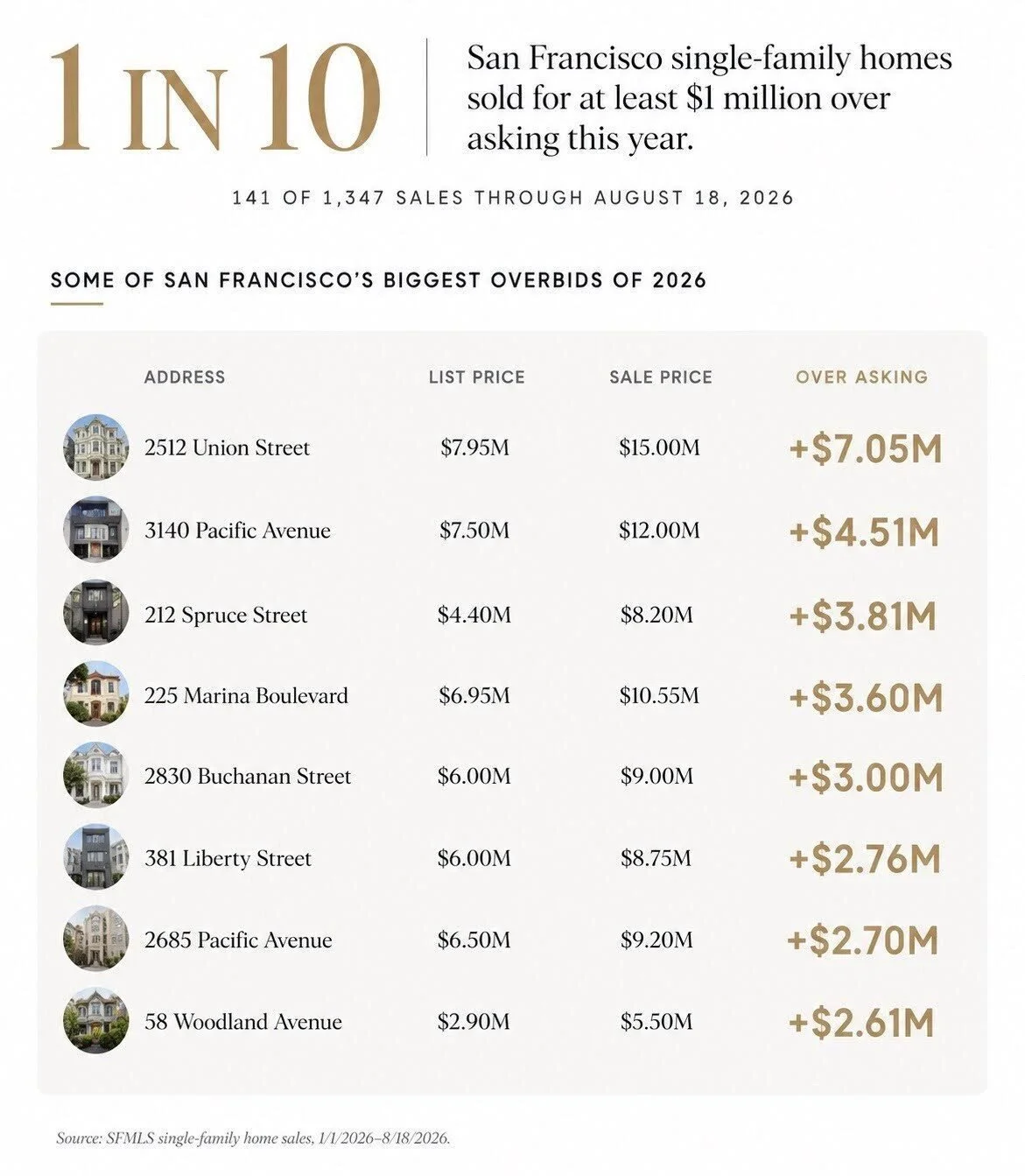
But the number that really stopped me: 141 San Francisco single-family homes have sold for at least $1 million over their list price this year. That's more than one in ten homes sold in this city selling for a million dollars — or more — above what was asked for it.
For comparison, I went back through all of 2025. Out of 2,182 single-family sales for the entire year, only 20 sold for $1 million or more over list price — less than 1%, or roughly one in every 109 homes.
2025: 1 in 109. 2026: 1 in 10.
And we're not even through the year yet.
Some of the individual sales genuinely make me pause, and I've been doing this a long time. A home on Union Street was listed at $7.95 million and closed at $15 million — $7.05 million over asking. Another, on Woodland Avenue, listed just under $2.9 million and sold for $5.5 million, nearly 90% above list.
I want to be clear about what these numbers do and don't mean. They're not simply stories of buyers wildly overpaying. In many cases, they're the result of a deliberate pricing strategy — list low, build a crowd, let the market set the price. "Sold 30% over asking" makes for a great headline, but it doesn't necessarily mean a buyer paid 30% more than the home was worth. It may just mean the home was intentionally priced well under what the comps already suggested it would fetch.
Why Pricing Is Both Art and Science
This is the part of the job I find genuinely fascinating, and it's worth understanding whether you're buying or selling.
Take a home worth roughly $2.2 million. Depending on strategy, it could be listed at $1.895 million, $2.095 million, $2.195 million, or $2.295 million — and each of those numbers sends the market a different signal and produces different buyer behavior. Counterintuitively, the highest list price doesn't always produce the highest sales price. Sometimes pricing lower is exactly what creates the competition needed to sell higher.
That said, this strategy isn't universal. A highly desirable single-family home with broad buyer appeal can respond beautifully to aggressive, below-market pricing. A condo, a luxury property, a tenant-occupied building, or anything with a narrower buyer pool often needs a completely different approach. Having spent years learning how San Francisco's building stock actually works — from Edwardian flats in the Mission to view condos in Pacific Heights to tenant-in-common properties that come with their own legal quirks — I can tell you there's no single "San Francisco pricing strategy." The right approach depends on the property, the neighborhood, the competition, and the moment.
For buyers: don't confuse asking price with affordability. A home listed at $1.8 million may not actually be competing in the $1.8 million market at all. On the flip side, a home listed at $2.2 million that's been sitting for a few weeks may offer more room to negotiate than the number suggests.
The bottom line: San Francisco homes aren't just selling well over asking — list price and market value are often two entirely different things. Understanding the strategy behind the number matters just as much as the number itself.
Heading Into Fall
This is exactly why pricing strategy matters as we move into San Francisco's fall market. After a notably supply-constrained spring and summer, we're starting to see the seasonal uptick in new inventory — more choices for buyers, though not necessarily less competition. Well-located, well-presented homes are still drawing serious attention, and buyers should be ready to move quickly when the right one shows up, while looking past the list price to where it's actually likely to trade.
Mortgage rates remain the wildcard — still bouncing around rather than making the sustained move downward that many buyers have been hoping for. I'm not a lender or a financial advisor, so I'd always encourage you to talk with your mortgage professional about how rate movement affects your specific numbers. But from where I sit, fall could present an interesting window: more inventory to choose from now, with any meaningful rate drop likely to bring even more buyers off the sidelines.
Why the Right Agent Matters More Than Ever
In a market this nuanced, who you work with matters enormously — especially if you're buying.
Buyers need someone who knows recent sales intimately — not just what a comparable property sold for, but why it sold for that price — and who has the experience to tell the difference between an intentionally low list price and a genuine deal. Reputation counts, too. In a competitive bidding situation, you want an agent the other side knows, trusts, and wants to work with. And just as important: a good buyer's agent knows when to encourage you to stretch, and when to help you walk away — bringing some practical perspective to a decision that can get very emotional, very fast.
Sellers should look for the same qualities: deep market knowledge, strong relationships, sound judgment, and an agent who understands that pricing a home isn't about picking a number. It's about picking a strategy.
Here’s a look at some of this year’s top overbids: